Contact Steve Collins at scollins@bristolpress.com
January 4, 2009
A roundup of new Bristol Press-related stories and columns
Contact Steve Collins at scollins@bristolpress.com


January 3, 2009
New London daily distressed at possible Press closure
The Day weighs in with an editorial lamenting the possible closure of The Bristol Press and New Britain Herald.
Here's an excerpot: "The two daily newspapers are a part of the fabric of everyday life in central Connecticut, as are newspapers across the country. They are the conduit that provides local municipal news and information on births, deaths, arrests, high school sports and more. Readers depend on their newspapers to stay informed. Television and the Internet might keep people abreast of what's happening in the Gaza Strip, but they won't tell them what the local zoning commission is up to or if the New Britain Golden Hurricanes won a big game."
The editorial also hails the state Department of Economic Development for doing "nothing extraordinary to save the Journal Register newspapers," which is exactly what lawmakers asked from it.
In any case, I'm glad to see The Day's support. Every little bit helps. Maybe.
Copyright 2008. All rights reserved.
Contact Steve Collins at scollins@bristolpress.com
Want to know why you don't know what's going on anymore?
There is something terribly depressing about this piece in Governing that features quite a bit on the collapse of state government news coverage in Connecticut. While independent online journalists like Christine Stuart at ctnewsjunkie.com are paving a path toward some kind of future, the simple reality is that right now the state is heading into a fiscal swamp and almost nobody's watching what our leaders are doing in all that muck.
When it comes to watchdogs, the more you have, the more likely you'll hear from at least one when there's something noteworthy going on. Stuart's a pretty solid reporter -- and I can't help but admire her pluck -- but she's not the equivalent of a Capitol press corps.
And as reporters vanish from the political landscape, ignorance of government rises. I can't imagine how Connecticut can function as a thriving democracy when almost nobody knows what the hell is going on anymore.
Copyright 2008. All rights reserved.
Contact Steve Collins at scollins@bristolpress.com
The early years of The Bristol Press
From the 1907 history of Bristol – Bristol, Connecticut: "in the Olden Time New Cambridge", which Includes Forestville -- by Eddy N. Smith, George Benton Smith, and Allena J. Dates, assisted by G.W.F. Blanchfield. Digitized by Google here.
THE BRISTOL PRESS

A. S. BARNES.
THE founder, editor and for seventeen years proprietor of The Bristol Press, was С. Н. Riggs. The first number of The Press was published on March 9, 1871. The Presswas started in a small way upon prepaid subscription and borrowed money with very insufficient material and machinery, but it made the best of circumstances and held on its course.
The paper owed its origin to the suggestion of Rev. W. W. Belden, then pastor of the Congregational Church, and to the helping purses of Messrs. N. L. Birge, Elias Ingraham, J. H. Sessions and Josian T. Peck, each of whom advanced forty dollars in aid of the enterprise. All were repaid out of the first year's profits. The subscription list at first consisted of about two hundred and fifty names.
The first office occupied by the paper and connected job printing business was the second story of a frame building twenty feet square, adjoining Seymour's block, next to the railroad. Here, with a Washington hand press for newspaper work, and a Novelty job press, the editor started a five-column folio "patent outside" paper, the type for the inside being mostly what had been worn out and thrown aside in an office in New York state.
The editor had gained some knowledge of type-setting and printing while teaching school, but was far from being expert in the art. However, with the assistance of a girl, who was greener at the business than he was, he resolutely set to work, and in the face of difficulties, he entered upon his new career.
Before the first year was ended new quarters were secured in E. Root's factory on lower Main street where with power presses, the business greatly increased. In 1877 a building was erected by H. S. Pratt on Main street, opposite Muzzy's corner and to this building the business was removed, Mr. Pratt becoming a partner.
Mr. Pratt remained in the partnership less than two years, when Mr. Riggs resumed the entire ownership. In 1880 another office was built in the rear of what was then Gale's studio on the east side of Main street. This building about 1890 was removed to Riverside avenue where The Press was published for seventeen years.
In August, 1888, Mr. Riggs the founder of the paper, disposed of the business to Messrs. Haviland & Duncan, of Southington. Mr. Thomas H. Duncan became editor and manager and remained as such until December, 1891, when the Bristol Press Publishing Co., with a capital stock of $10,000, purchased the business. The first officers of the company were: O. F. Strunz, President; J. H. Sessions, Jr., Vice President; S. K. Montgomery, Secretary; Richard Baldwin, Treasurer. Mr. C. H. Riggs was employed as editor and manager until April, 1893, when he was succeeded by Mr. H. H. Palmer of New Haven. Mr. Palmer remained with The Press less than a year when Mr. Wallace H. Miller took charge of the paper as editor and manager.
The photograph herewith reproduced [at the bottom of this blog entry], represents Mr. Riggs and his office force, probably in 1882. At the left are Walter H. Royce and Miss Bertha Evans. In the door at the right stands George A. Fish; farther in front is Herbert E. Garrett, and seated by Mr. Riggs is Sidney M. Card. In the doorway at the left stands Rev. Asher Anderson, the pastor of the Congregational Church at that time.
Mr. Wallace H. Miller continued as editor of The Press and manager of the Bristol Press Publishing Co. until February, 1901, when he was succeeded by Mr. Chas. F. Olin. Mr. Olin remained with The Press as editor until June, 1907, but in March, 1902, he was succeeded by Arthur S. Barnes as manager. Mr. Barnes is a Bristol boy and was born on March 12, 1871, the very year and month in which The Press made its initial appearance before the people of Bristol.
Under Mr. Barnes' management The Press has been increased from a six column to a seven column paper and the number of pages from eight to ten, twelve and sometimes sixteen. Associated with him in carrying on the work are Wallace H. Miller as editor and Thomas A. Tracy as assistant. Mr. Miller returned to The Press in June, 1907. The officers of the Bristol Press Publishing Co. are—President, Gilbert H. Blakeslev; Secretary and Treasurer, Arthur S. Barnes; Directors, Gilbert H. Blakesley, Otto F. Strunz and Arthur S. Barnes.
In January, 1907, the land on Riverside avenue occupied by The Press building was sold to Mr. Wm. E. Sessions and a plot 53 by 90 feet was purchased from Mrs. Edward E. Newell on Main street, the former site of S. E. Root's factory. A two-story brick building has been erected there, and in September, 1907, The Press removed to its new home. This new building is 74 by 36 feet and is of mill construction throughout, and is situated on the very same spot where The Press was quartered in S. E. Root's factory from 1872 to 1877.
The Press considers it as its first duty to faithfully chronicle local events in Bristol and to reflect public opinion on local affairs. In politics it is independent, believing that such is the only course that a local paper can take. It strives always to live up to the commendation of one of its former editors who spoke of it as "a high-grade, influential home newspaper, one that always works for the welfare of the town and its best interests."

January 2, 2009
Save The Bristol Press cartoon
My talented friend Justin Skaradosky, a senior at Bristol Central High School and a Tattoo mainstay for several years now, drew this:

Here's a closeup of what future Bristol residents might be getting for news while their city is destroyed:

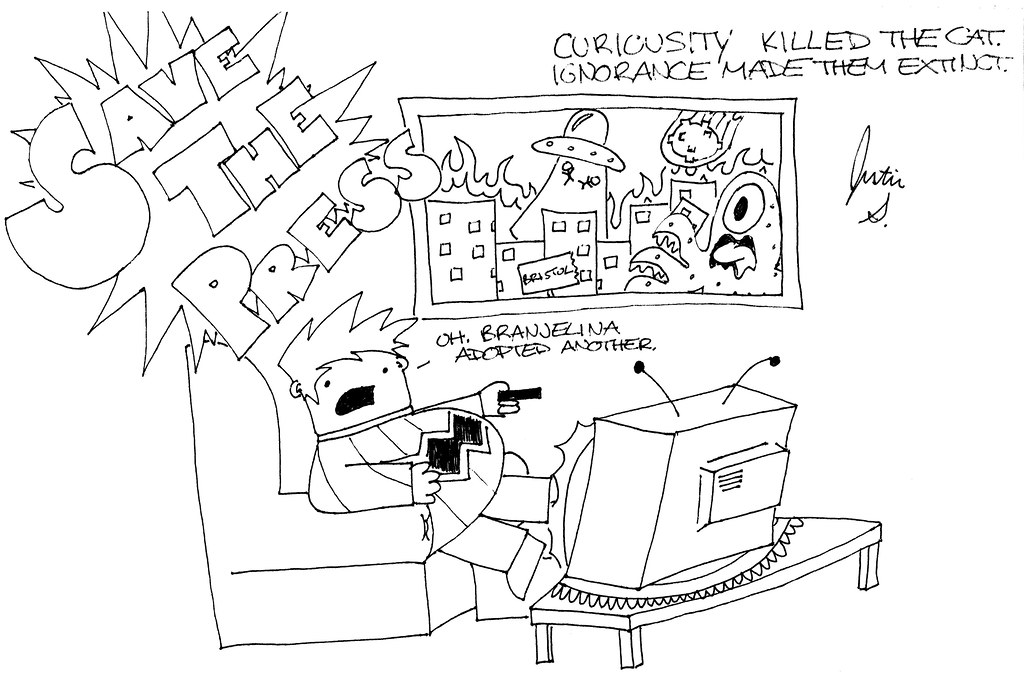
Thank you, Justin!
*******
Copyright 2008. All rights reserved.
Contact Steve Collins at scollins@bristolpress.com
Copyright 2008. All rights reserved.
Contact Steve Collins at scollins@bristolpress.com
Mid-size cities seeking relief plan to unveil agenda Tuesday
A group of 17 mid-size Connecticut cities and towns plans Tuesday to introduce a legislative agenda calling for relief from unfunded mandates, new revenue sources and fast-track approval for local projects.
“These are radical times,” Mayor Art Ward. “We need to think away from the norm” to help taxpayers get through them.
The group intends to unveil its agenda at a state Capitol news conference Tuesday in hopes of convincing Gov. Jodi Rell and the legislature to take measures to relieve the growing fiscal strain on Connecticut’s mid-size municipalities.
Officials in the towns say that the eight most troubled cities, including New Britain, get plenty of attention from lawmakers, but the problems of the next tier of municipalities are too often overlooked.
According to a Dec. 30 email from West Hartford Mayor Scott Slifka to his counterparts in other smaller cities, the group should try to convince the state to “suspend all unfunded mandates for a minimum of two years.”
Among the mandates Slifka said the cities and towns need help from are laws raising the age of juvenile court jurisdiction to include 16- and 17-year-olds, a requirement to offer in-school suspensions to most students and a delay in required revaluations.
But Ward said that the changes that would most help are mostly in the field of education, where a barrage of mandates adds millions of dollars to the city’s school budget. Many of those mandates, however, come down from the federal government.
School Superintendent Philip Streifer has been one of the leading voices in Connecticut education in his calls for relief from the many mandates, at least until the financial crisis passes. He said that waiving testing, professional development days and other requirements would make a large difference.
As it is, to keep pace with the current educational offerings would add 2 mills to the mill rate in Bristol this year, the mayor said, adding that more state aid or mandate relief is a necessity to bring that number down.
“It’s going to have to come down,” Ward said.
Ward said that what the small cities group, which doesn’t have a formal name yet, aims to do is to try to ensure that “somebody looks responsibly at the impact on taxpayers” of so many existing policies.
Slifka’s memo said that municipalities should also have the opportunity to “directly share in new revenue sources” the state may develop, such as an income tax or sales tax hike.
“While we do not endorse the concept of raising taxes to deal with the current crisis,” Slifka said, “to the extend that the state enacts new revenue streams or expands upon current ones” a portion of the money raised “should be set aside for direct distribution to municipalities.”
Slifa said that state transportation and environmental regulators should fast track any projects and permits sought for projects scheduled for 2009 so that bidding can be done this spring.
With infrastructure projects likely to be funded by the new administration, Ward said, it’s important they not be stymied by bureaucrats. He said that any federal cash should flow straight to municipalities to hasten timetables for “shovel ready” projects.
Included in the new group are Bristol, East Hartford, East Haven, Enfield, Fairfield, Groton, Hamden, Manchester, Meriden, Middletown, New London, Stratford, Torrington, Vernon, West Hartford, and West Haven.
Copyright 2008. All rights reserved.
Contact Steve Collins at scollins@bristolpress.com
Cockayne hails revamped GASB 45 panel
Revamping a city panel looking into the possibility of using surplus pension cash to cover retirees’ health care offers hope for hard-pressed taxpayers, says the city councilor who has pushed hardest for the plan.
City Councilor Ken Cockayne, a freshman Republican, said he’s glad that Mayor Art Ward removed union members who had a conflict-of-interest serving on the first incarnation of the GASB 45 Committee.
“I commend the mayor for taking the action he did correcting the mistake,” Cockayne said.
“We all make mistakes,” Cockayne said, and he’s content that Ward recognized the initial 19-member panel wasn’t the right answer. The new committee has seven members.
The GASB 45 Committee, named for an accounting rule, will examine the prospects for saving millions for taxpayers by transferring pension fund excesses to new accounts set up to cover the future tab for health care coverage for retirees.
With experts telling the city it needs $72 million to fund the new accounts, it’s clear that the city has to consider seriously the option of using money that’s already available instead of trying to hike taxes for many years to come, the councilor said.
Cockayne, who was appointed to the original committee, blasted Ward at the time for putting at least nine union-connected members on the 19-person panel the mayor created. He also called Ward “cowardly” for not serving on the panel himself.
After terming Cockayne’s charges “totally disgusting,” Ward removed Cockayne from the committee.
But when the panel’s chairman, T.J. Barnes, asked the mayor to cut the size of the panel to seven and cease including beneficiaries on the committee, Ward agreed.
Cockayne said he erred in calling the mayor a coward.
“I do apologize for calling the mayor a coward,” Cockayne said. “I let my passion get the best of me.”
Cockayne said the issue is of crucial importance for the community because it could mean lower mill rates for years to come.
“This issue is win-win for everyone,” Cockayne said.
Copyright 2008. All rights reserved.
Contact Steve Collins at scollins@bristolpress.com
News, pols, blogs and what's going on
Here's an interesting piece in The Everyday Republican about the way news and blogs get all mixed up nowadays.
Copyright 2008. All rights reserved.
Contact Steve Collins at scollins@bristolpress.com
January 1, 2009
Lavoie comes home for the holidays

 U.S. Army Corporal Matt Lavoie grew up in two-story white house in northeastern Bristol, just down the street from Kern Park.
An American flag waves on a pole his father installed in the backyard last summer, with a blue and white 3rd Infantry Division banner fluttering right beneath it.
The stars and stripes hang from a front porch pole as well, with a wooden wishing well on the snowy ground nearby.
Inside is a glittery Christmas tree surrounded with presents, but there’s no doubt what the greatest gift the Lavoie family received this holiday season.
Their son, mangled in a Sept. 30 roadside bomb explosion in Iraq, came home.
“We could have been up on Chippens Hill putting flowers on a grave,” his father, Sam Lavoie said. “We have a lot to be thankful for.”
Lavoie, whose arm looks like a jigsaw puzzle of skin grafts and other repairs, said he is happy for the chance to return to Bristol.
Sitting at his family’s dining room table with his father and his mother Pam, Lavoie said the injuries he received “are not going to stop me from living.”
Lavoie, who still has at least another eight operations ahead of him to try to regain full use of his right hand, was driving a Humvee in the lead position of a patrol in an unsettled area of Iraq when an explosion tossed it six feet into the air.
He wound up pinned to the steering column through his right leg, his right arm limp and gushing blood, his gun snapped in half.
Somehow, Lavoie pulled himself off the metal rod that had pierced his leg and flailed out onto the dirt, where friends dragged him to safety as he struggled to stay and fight.
He nearly died, Lavoie said, but eventually pulled through to the safety of Walter Reed Army Medical Center in the nation’s capital, where surgeons are painstakingly putting his arm back together.
Lavoie got the green light to return home before Christmas. He needs to return to the hospital on Jan. 11.
He said he wished he could have come back to Bristol a month earlier for a community fundraiser that drew 500 people to Nuchies and raised $15,000 for his family. He said he wanted to convey his thanks to everyone and to his mother's boss, Carrie Tonon, who organized the effort.
“I couldn’t believe the whole town would come together” to lend him a hand, Lavoie said.
He said that everywhere he goes in Bristol now, people thank him for his service.
A man who recognized him from the picture that ran in The Bristol Press asked him, “Dude, are you the one who got blown up?”
Lavoie said that despite all the support, it’s still hard.
He has two bolts “kind of popping out of the skin” in his elbow, he said, which “kind of hurts.”
Lavoie has little feeling in his right fingers and not much elsewhere in his arm, which was so torn and shattered that he still wonders if he’d have been better off to lose it entirely.
“I wake up so stiff sometimes that I can’t get up,” he added, leaving him with the sense that his battered body is more like an 80-year-old man’s than one belonging to a former star wrestler who graduated from Bristol Eastern High School in 2005.
“My body has been through absolute hell,” Lavoie said.
He said he gets “a lot of flashbacks” to the explosion and other horrors in Iraq that are seared into his memory.
“Crowds get to me,” too, Lavoie said, and he “freaked” when he had to wade through a big assemblage at an airport on the way home.
He remains “absolutely terrified” of cars, he said, and loud noises can send him sprawling to the ground.
At Stop and Shop, Lavoie said, a bang caused him to hit the deck in the cereal aisle.
Lavoie his “teeth are getting kind of strong” as he uses them to pull zippers, open a can of soda or beer, and more. He set up a Blu-Ray home theater system with his one good hand.
“I really can’t do anything” with the right arm, Lavoie said. “I feel like it’s just dead.”
Still, Lavoie said he hopes that doctors will succeed in restoring at least 80 percent of his hand’s function. He said he’s angling for 100 percent.
Recovering at Walter Reed, where Lavoie spent six weeks flat on his back, he said he got pretty depressed.
But one say New York Yankees great Yogi Berra came through and that made him happy.
After that, a parade of celebrities stopped by, including comedian Robin Williams, Green Bay Packers quarterback Aaron Rogers, Pat Tillman’s mother and his favorite, Jason Bryant Acuña, who plays Wee Man on the television show “Jackass.”
“He jumped up on my bed and just talked,” Lavoie said.
Lavoie said he’s not the same person he was before the bomb went off.
“When you’re that close to death, it changes you,” Lavoie said.
“I went from a punk to a man,” Lavoie said.
With luck, Lavoie said, he’ll be able to return to active duty.
“I’d put my boots on right away,” Lavoie said.
He said that if he can stay in the infantry, he’ll stay in the Army, though his plans to become a Ranger are likely never going to happen now.
If he can’t keep fighting for his country, Lavoie said he’d like to become a SWAT team member when he recovers. If that proves impossible, Lavoie said, he might try firefighting or perhaps become a history teacher.
“When I get older, I think I’ll run for mayor,” Lavoie said, with a hint of mischief.
I will add more information this weekend, including Lavoie's memories of Iraq and perhaps something special beyond that next week.
*******
Copyright 2008. All rights reserved.
Contact Steve Collins at scollins@bristolpress.com
Nicastro bombarded with media calls today
State Rep. Frank Nicastro said he's "getting phone calls from all over the country" asking him about a Reuters news story that portrays him as leading an effort to 'bail out' The Bristol Press.
Reuters "twisted that story horribly," the Bristol Democrat said.
He said he's spoken with reporters in Georgia, Minnesota, Washington, Florida and elsewhere who wanted to quiz him about the effort to save two Central Connecticut dailies, including the Press.
Nicastro said he tells them all that "I'm not recommending 5 cents to the current owner" of the papers, the Pennsylvania-based Journal Register Co.
Instead of a bailout, he said, he explains that the effort is focused on making sure any prospective new owner learns about state programs available to any business owner that might lead to tax breaks or low-interest loans to encourage development and preserve jobs.
Nicastro said that once he explains what's really going on, those calling tell him he's doing the right thing.
Nicastro said it's been an unusual start to a new year.
"It's sad, but it's interesting," Nicastro said.
*******
Copyright 2008. All rights reserved.
Contact Steve Collins at scollins@bristolpress.com
Reuters "twisted that story horribly," the Bristol Democrat said.
He said he's spoken with reporters in Georgia, Minnesota, Washington, Florida and elsewhere who wanted to quiz him about the effort to save two Central Connecticut dailies, including the Press.
Nicastro said he tells them all that "I'm not recommending 5 cents to the current owner" of the papers, the Pennsylvania-based Journal Register Co.
Instead of a bailout, he said, he explains that the effort is focused on making sure any prospective new owner learns about state programs available to any business owner that might lead to tax breaks or low-interest loans to encourage development and preserve jobs.
Nicastro said that once he explains what's really going on, those calling tell him he's doing the right thing.
Nicastro said it's been an unusual start to a new year.
"It's sad, but it's interesting," Nicastro said.
*******
Copyright 2008. All rights reserved.
Contact Steve Collins at scollins@bristolpress.com
JI editor sure doesn't sound like he's buying newspapers
Read Journal Inquirer Managing Editor Chris Powell's latest column and you sure don't get a sense that he's advising anyone to snap up The Bristol Press or, especially, The New Britain Herald.
In a lucid argument that state tax breaks aren't going to make a difference to newspaper owners, Powell points the finger at the real problem: that Connecticut's cities are too poor to support dailies anymore, except maybe in Stamford.
"The decline of newspapers reflects community disintegration," Powell correctly argues, and the way to save them is to fix our state, our society, ourselves.
"Newspapers don't need tax breaks," Powell says in the piece. "They need what the state itself needs, a middle class – self-sufficient households with two parents who are involved with their kids, schools, churches, civic groups, and such, interests that attach people to community and thus, almost inevitably, to newspapers, the chroniclers of community."
In New Britain, where The Herald is struggling, 40 percent of the residents speak something other than English as their first language, Powell says. How are they going to become readers of the community daily?
"New Britain is desperately poor," Powell says, and lacks the sort of rich suburbs that might make it possible for a daily to survive anyway.
"So among Connecticut's cities New Britain probably is least able to support a daily paper," Powell says, which ought to put to rest any thought that the JI is going to buy it.
On the other hand, Powell's column seems to contain a hint of interest in an old plan to come at The Hartford Courant from its fat, wealthy and uncompetitive suburbs.
I know that West Hartford, where almost everyone seems to get the Courant, feels that it's mostly ignored by the paper. The West Hartford News, the Journal Register Co.-owned weekly, doesn't fill the vacuum at all.
I'm not sure the JI has the financial werewithal or interest in trying to have some kind of JI West that could take the Courant on from the other side of the state capital, but it might.
Maybe we'll know more in the coming week.
I'm skeptical the JI is coming to our rescue, but I do know that whatever happens to us, Hartford's decisionmakers should pay attention to Powell's policy prescriptions.
We don't need the whole state to keep slipping down the slippery path that has swallowed up too many of its cities and too many of its residents' dreams.
*******
Copyright 2008. All rights reserved.
Contact Steve Collins at scollins@bristolpress.com
In a lucid argument that state tax breaks aren't going to make a difference to newspaper owners, Powell points the finger at the real problem: that Connecticut's cities are too poor to support dailies anymore, except maybe in Stamford.
"The decline of newspapers reflects community disintegration," Powell correctly argues, and the way to save them is to fix our state, our society, ourselves.
"Newspapers don't need tax breaks," Powell says in the piece. "They need what the state itself needs, a middle class – self-sufficient households with two parents who are involved with their kids, schools, churches, civic groups, and such, interests that attach people to community and thus, almost inevitably, to newspapers, the chroniclers of community."
In New Britain, where The Herald is struggling, 40 percent of the residents speak something other than English as their first language, Powell says. How are they going to become readers of the community daily?
"New Britain is desperately poor," Powell says, and lacks the sort of rich suburbs that might make it possible for a daily to survive anyway.
"So among Connecticut's cities New Britain probably is least able to support a daily paper," Powell says, which ought to put to rest any thought that the JI is going to buy it.
On the other hand, Powell's column seems to contain a hint of interest in an old plan to come at The Hartford Courant from its fat, wealthy and uncompetitive suburbs.
I know that West Hartford, where almost everyone seems to get the Courant, feels that it's mostly ignored by the paper. The West Hartford News, the Journal Register Co.-owned weekly, doesn't fill the vacuum at all.
I'm not sure the JI has the financial werewithal or interest in trying to have some kind of JI West that could take the Courant on from the other side of the state capital, but it might.
Maybe we'll know more in the coming week.
I'm skeptical the JI is coming to our rescue, but I do know that whatever happens to us, Hartford's decisionmakers should pay attention to Powell's policy prescriptions.
We don't need the whole state to keep slipping down the slippery path that has swallowed up too many of its cities and too many of its residents' dreams.
*******
Copyright 2008. All rights reserved.
Contact Steve Collins at scollins@bristolpress.com
Regulators crack down on Bristol Hospital
The state Department of Public Health and Bristol Hospital signed a consent decree this week that mandates the hospital take steps to improve care. Here is a copy of the decree.
Here's a news story I batted out this afternoon:
After state inspectors found numerous problems with the care offered at Bristol Hospital, the hospital and state regulators signed a consent order this week that promises high quality care and slaps the hospital with a $4,000 fine.
The state Department of Public Health disciplined the hospital after inspectors found a series of violations that included a serious burn from an MRI machine.
The inspections, which occurred between April and October last year, also found a number of instances where patients received inadequate care.
The consent decree spells out changes the hospital is required to make during the next two years in order to improve the quality of its care and to ensure the safety of patients.
The hospital says it has “already implemented many of the points” contained in the Dec. 30 consent decree.
“Bristol Hospital is committed to providing the highest quality care in the safest possible environment,” Kurt Barwis, president of the hospital, said in statement.
“We are the ninth hospital in Connecticut this year to sign a consent agreement.,” Barwis added.
“We recognize that this process helps us to improve the care we provide.We will see to it that the opportunities for improvement directly benefit our patients and our community,” he said.
The hospital said it is reviewing its policies and procedures to make sure medications are administered and documented correctly, that patients are informed of care plans and much more.
“Every employee and member of our medical staff is 100% committed to providing outstanding patient care,” Barwis said.
“We will continue to refine our systems and processes, adopt appropriate quality improvement strategies, and engage all of those involved in the delivery of care throughout the organization to ensure a culture of safety and quality,” the hospital chief said.
In one case, inspectors determined that in October 5, 2007, a woman came in with congestive heart failure. She asked for cardiac resuscitation and ventilation if necessary, but no feeding tube or tracheostomy.
As her condition deteriorated, her code status was revised to “comfort status only” though there was nothing in the records to indicate she’d been consulted. She died that evening with only a morphine drip to keep her from pain.
That same patient was also given more morphine than records called for..
Most of the problems in the state report, which is available online, related to the administration and recordkeeping of medicine and providing information to patients.
But in one case that inspector found, a man getting an MRI last January did not receive the protective padding required and wound up with a severe burn that was so deep that doctors eventually had to cut down to an arm muscle to care for it.
The hospital issued this statement in response to the decree:
On December 30, 2008 Bristol Hospital signed a consent order with the Connecticut Department of Public Health. This order resulted from several inspections carried out by the Department of Public Health between April 2008 and October 2008. This agreement spells out specific issues that Bristol Hospital needs to address over the next two years in order to improve the quality and ensure the safety of the care that is provided to patients. Bristol Hospital has already implemented many of the points agreed to in the order and have been approved by the State.
“Bristol Hospital is committed to providing the highest quality care in the safest possible environment,” stated Kurt Barwis, President and CEO of Bristol Hospital. “We are the ninth hospital in Connecticut this year to sign a consent agreement. We recognize that this process helps us to improve the care we provide. We will see to it that the opportunities for improvement directly benefit our patients and our community.”
As part of the consent agreement between Bristol Hospital and DPH, Bristol Hospital has already implemented extensive reviews of policies and procedures regarding the administration and documentation of medications; revised policies and procedures related to informed patient rights related to plan of care and advanced directives; enhanced education for staff on patient assessments and current standards and practice related to pharmacology regimes, including medication titration protocols; and the review of policies and procedures related to MRI safety precautions and practices.
“Every employee and member of our medical staff is 100% committed to providing outstanding patient care,” stated Barwis. “We will continue to refine our systems and processes, adopt appropriate quality improvement strategies, and engage all of those involved in the delivery of care throughout the organization to ensure a culture of safety and quality.”
*******
Copyright 2008. All rights reserved.
Contact Steve Collins at scollins@bristolpress.com
Here's a news story I batted out this afternoon:
After state inspectors found numerous problems with the care offered at Bristol Hospital, the hospital and state regulators signed a consent order this week that promises high quality care and slaps the hospital with a $4,000 fine.
The state Department of Public Health disciplined the hospital after inspectors found a series of violations that included a serious burn from an MRI machine.
The inspections, which occurred between April and October last year, also found a number of instances where patients received inadequate care.
The consent decree spells out changes the hospital is required to make during the next two years in order to improve the quality of its care and to ensure the safety of patients.
The hospital says it has “already implemented many of the points” contained in the Dec. 30 consent decree.
“Bristol Hospital is committed to providing the highest quality care in the safest possible environment,” Kurt Barwis, president of the hospital, said in statement.
“We are the ninth hospital in Connecticut this year to sign a consent agreement.,” Barwis added.
“We recognize that this process helps us to improve the care we provide.We will see to it that the opportunities for improvement directly benefit our patients and our community,” he said.
The hospital said it is reviewing its policies and procedures to make sure medications are administered and documented correctly, that patients are informed of care plans and much more.
“Every employee and member of our medical staff is 100% committed to providing outstanding patient care,” Barwis said.
“We will continue to refine our systems and processes, adopt appropriate quality improvement strategies, and engage all of those involved in the delivery of care throughout the organization to ensure a culture of safety and quality,” the hospital chief said.
In one case, inspectors determined that in October 5, 2007, a woman came in with congestive heart failure. She asked for cardiac resuscitation and ventilation if necessary, but no feeding tube or tracheostomy.
As her condition deteriorated, her code status was revised to “comfort status only” though there was nothing in the records to indicate she’d been consulted. She died that evening with only a morphine drip to keep her from pain.
That same patient was also given more morphine than records called for..
Most of the problems in the state report, which is available online, related to the administration and recordkeeping of medicine and providing information to patients.
But in one case that inspector found, a man getting an MRI last January did not receive the protective padding required and wound up with a severe burn that was so deep that doctors eventually had to cut down to an arm muscle to care for it.
The hospital issued this statement in response to the decree:
On December 30, 2008 Bristol Hospital signed a consent order with the Connecticut Department of Public Health. This order resulted from several inspections carried out by the Department of Public Health between April 2008 and October 2008. This agreement spells out specific issues that Bristol Hospital needs to address over the next two years in order to improve the quality and ensure the safety of the care that is provided to patients. Bristol Hospital has already implemented many of the points agreed to in the order and have been approved by the State.
“Bristol Hospital is committed to providing the highest quality care in the safest possible environment,” stated Kurt Barwis, President and CEO of Bristol Hospital. “We are the ninth hospital in Connecticut this year to sign a consent agreement. We recognize that this process helps us to improve the care we provide. We will see to it that the opportunities for improvement directly benefit our patients and our community.”
As part of the consent agreement between Bristol Hospital and DPH, Bristol Hospital has already implemented extensive reviews of policies and procedures regarding the administration and documentation of medications; revised policies and procedures related to informed patient rights related to plan of care and advanced directives; enhanced education for staff on patient assessments and current standards and practice related to pharmacology regimes, including medication titration protocols; and the review of policies and procedures related to MRI safety precautions and practices.
“Every employee and member of our medical staff is 100% committed to providing outstanding patient care,” stated Barwis. “We will continue to refine our systems and processes, adopt appropriate quality improvement strategies, and engage all of those involved in the delivery of care throughout the organization to ensure a culture of safety and quality.”
*******
Copyright 2008. All rights reserved.
Contact Steve Collins at scollins@bristolpress.com
Subscribe to:
Posts (Atom)